If you’ve searched for Tristan meaning in Hebrew, you’ve probably found two different answers: one says it means “sorrowful,” and another says it’s tied to faith and loyalty in Hebrew. Neither of those tells the whole story. Here’s what the name’s history actually shows, and why it doesn’t need a Hebrew origin to carry real meaning for Christian families.
Where Tristan Actually Comes From
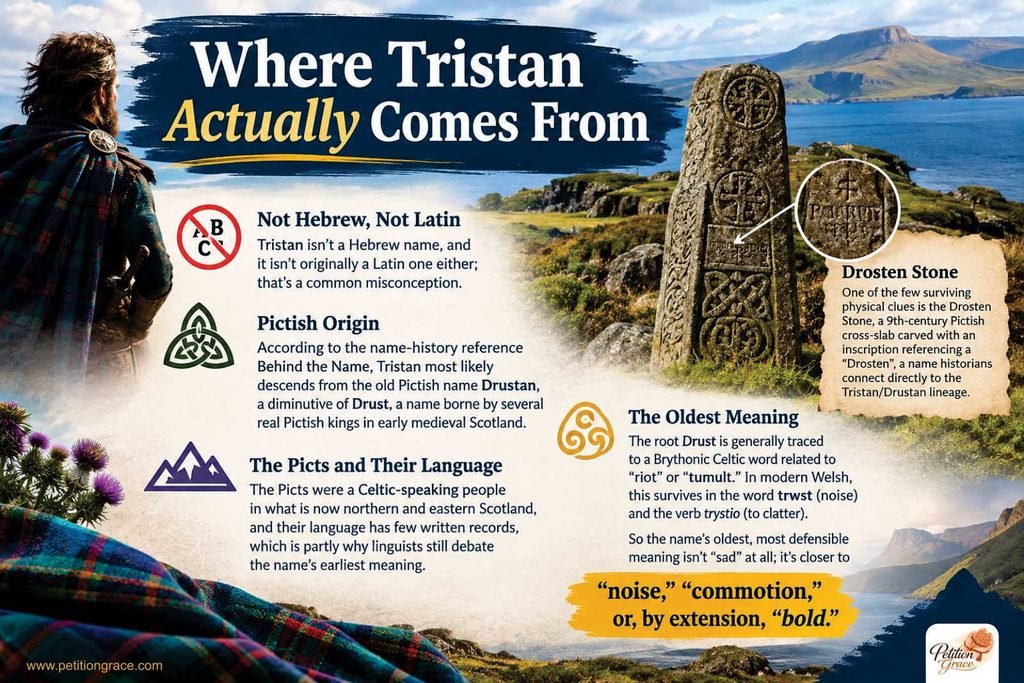
Tristan isn’t a Hebrew name, and it isn’t originally a Latin one either; that’s a common misconception. According to the name-history reference Behind the Name, Tristan most likely descends from the old Pictish name Drustan, a diminutive of Drust, a name borne by several real Pictish kings in early medieval Scotland. The Picts were a Celtic-speaking people in what is now northern and eastern Scotland, and their language has few written records, which is partly why linguists still debate the name’s earliest meaning.
One of the few surviving physical clues is the Drosten Stone, a 9th-century Pictish cross-slab carved with an inscription referencing a “Drosten”, a name historians connect directly to the Tristan/Drustan lineage. It’s one of the only pieces of hard evidence we have for the name existing before it became a literary legend.
The root Drust is generally traced to a Brythonic Celtic word related to “riot” or “tumult; in modern Welsh, this survives in the word trwst (noise) and the verb trystio (to clatter). So the name’s oldest, most defensible meaning isn’t “sad” at all; it’s closer to “noise,” “commotion,” or, by extension, “bold.”
How “Sorrowful” Got Attached to the Name
The “sad” meaning most baby-name sites repeat today comes from a folk etymology, not the name’s actual root. When the Tristan legend was written down in 12th-century France, French scribes adapting the Welsh/Cornish/Breton story noticed the name sounded like the Old French word triste (“sad”). Since the story itself is a tragedy, Tristan and Isolde both die at the end, the resemblance stuck, and later writers leaned into it deliberately, letting the name’s sound reinforce the story’s mood.
This is a well-documented pattern in name history: a name’s meaning and its sound-alike association can diverge, and popular retellings often keep whichever one fits the story better. In Tristan’s case, that’s why you’ll see two “official” meanings listed side by side almost everywhere: noise/boldness (the older, Celtic root) and sorrow (the later, French wordplay).
So Is There Any Hebrew Connection at All?
No, and it’s worth saying clearly rather than working around it. If you’re specifically researching Tristan’s meaning in Hebrew, the honest answer is that the name does not appear in the Hebrew Bible, has no attested Hebrew root, and isn’t linked to any Hebrew word by serious etymological sources. Its lineage runs Pictish → Welsh/Cornish/Breton → Old French → English, with zero overlap with ancient Hebrew.
Some websites connect it to the Hebrew word for “faithful” (ne’eman) or a transliteration of “trust.” These aren’t translations or historical links; they’re modern, invented associations based on the name’s feel, not its history. It’s fine to draw spiritual inspiration from a name’s sound, but it’s worth knowing the difference between that and an actual etymology, especially if accuracy matters to you.
Why the Name Still Resonates With Biblical Themes
Here’s where the name gets genuinely interesting for Christian families, not because of a fake Hebrew root, but because its real meaning (sorrow, by the popular reading) touches one of the most repeated patterns in Scripture: that grief and hardship are not where the story ends.
- Job lost nearly everything and still refused to curse God, and the book ends with his restoration (Job 42:10–17).
- David wrote many of the Psalms directly out of grief; Psalm 30 in particular moves from mourning to dancing within a single poem.
- Paul catalogued his own suffering in detail in 2 Corinthians 11:23–27, yet in Romans 5:3–4 describes suffering as something that produces endurance, character, and hope, in that order.
None of them are named Tristan, and the Bible never uses the name symbolically; that link doesn’t exist, and this isn’t a case for pretending otherwise. But if the name’s meaning draws you to it, this is the honest parallel: Scripture consistently treats sorrow as material for growth rather than a dead end.
| Verse | What it says | How it connects to Tristan’s meaning |
|---|---|---|
| Psalm 30:5 | Weeping lasts only for a night; joy comes in the morning | Directly mirrors the “sorrow that doesn’t stay” theme |
| Romans 5:3–4 | Suffering produces perseverance, then character, then hope | Reframes hardship as a process, not a verdict |
| 2 Corinthians 12:9 | God’s strength is made complete in human weakness | Ties sorrow to strength rather than opposing them |
| Matthew 5:4 | Those who mourn will be comforted | A direct promise attached to grief specifically |
Tristan in the Legend vs. a Christian Reading
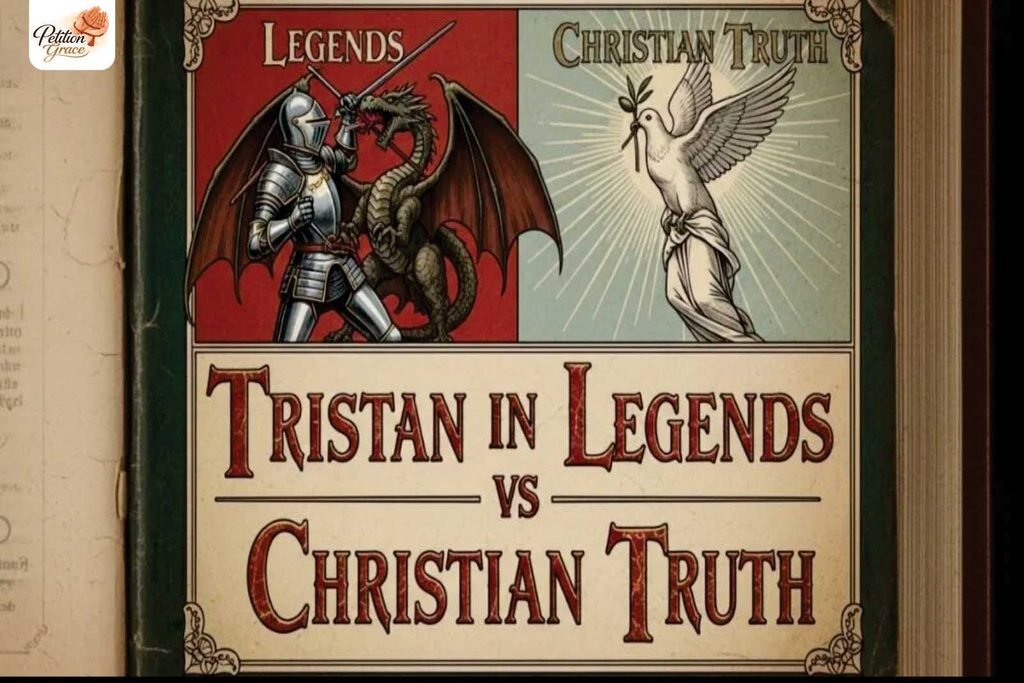
It’s worth being honest about where the original story and a faith-based reading actually diverge, instead of blending them:
In the medieval legend, Tristan and Isolde fall in love by accident, through a potion meant for someone else, and their love is treated as something neither of them can escape; fate overrides their choices, and the story ends in both their deaths. It’s a story about being ruled by circumstance.
A Christian reading of the name’s themes points somewhere different: that hardship isn’t fate closing in, but something that can be met with faith and purpose (James 1:2–4), and that sorrow is explicitly promised an end (Revelation 21:4), not just an accidental one.
These two framings aren’t the same story with different decoration; they’re genuinely different claims about what suffering means, which is exactly why it’s worth separating “the legend” from “what a Christian parent might take from the name” instead of merging them into one vague narrative.
Is Tristan a Good Choice for a Christian Family?

There’s no rule in Christian naming tradition requiring a name to appear in Scripture; the majority of names Christian parents use today (Ethan, Chloe, Mia, Owen) aren’t biblical names either, and nobody treats that as disqualifying. What matters more is whether the name’s associations are ones you’re comfortable growing into with a child.
For Tristan, that honestly means:
- A name from a medieval European legend, not a biblical figure
- A meaning that’s genuinely disputed between “noise/boldness” and “sorrow,” depending on which root you trust
- No negative associations in Christian tradition, and a long history of respectable use; it was popularized further by Laurence Sterne’s 1759 novel The Life and Opinions of Tristram Shandy and by Wagner’s 1865 opera Tristan und Isolde, and it sat in the U.S. Top 100 through most of the 2000s
Name Variations by Region
| Variation | Region | Note |
|---|---|---|
| Drustan / Drust | Pictish | The oldest attested form |
| Drystan / Trystan | Welsh | Preserves the Celtic “noise” root most directly |
| Tristram | English | Popularized by Tristram Shandy |
| Tristán | Spanish | Standard Spanish adaptation |
| Tristão | Portuguese | Standard Portuguese adaptation |
Conclusion
If you came here looking for the Tristan meaning in Hebrew, the honest takeaway is that it isn’t a Hebrew name, and pretending otherwise doesn’t add anything real to it; the actual history is more interesting anyway: a Pictish king’s name, carried through Welsh legend, reshaped by a French wordplay that turned “noise” into “sorrow” for the sake of a tragic love story. If you’re drawn to the name for a child, you don’t need an invented Hebrew root to give it spiritual weight. The name’s real, documented meaning, sorrow, already lines up with one of the Bible’s clearest promises: that grief is never the final word.
FAQ’s
What is the meaning of Tristan in the Bible?
It is not directly in the Bible, but it can represent perseverance and hope in faith.
What is the meaning of Tristan?
Tristan is traditionally linked to the Latin word tristis, meaning sorrowful. Over time, the name has come to symbolize resilience, emotional strength, and perseverance. Many people also associate Tristan with loyalty, courage, and personal growth through life’s challenges.
What is the Tristan meaning in Bible verse context?
It reflects enduring trials with faith, similar to biblical figures.
What is the Tristan meaning in Greek?
It is not originally Greek, so no direct meaning in that language.
What is the Tristan meaning in Hebrew?
Tristan does not have a direct Hebrew origin. However, many people associate the name with biblical themes such as faith, perseverance, loyalty, and spiritual strength.
What does the name Tristan say about personality?
It may suggest someone strong, resilient, and faithful.
How is Tristan pronounced in the Bible context?
It is pronounced the same: Tris-tan.
What is the Tristan meaning in Bible Catholic interpretation?
Catholic meaning aligns with Christian values: strength through trials.
What is the Tristan meaning in Hindi?
It is not a traditional Hindi name, so the meaning may differ in that culture.
Is the name Tristan in the Bible?
No, it is not directly mentioned in Scripture.
Why do parents choose Tristan?
Parents love Tristan’s name, meaning Hebrew, because it combines courage, perseverance, and spiritual depth for their child’s character development.
Is Tristan a Biblical Name?
No, Tristan is not a biblical name and does not appear in the Bible. The name originated outside of Hebrew Scripture and is commonly associated with Celtic and medieval traditions. However, many Christians still appreciate the name because its symbolic themes of endurance, faith, loyalty, and hope closely reflect biblical teachings. While Tristan is not mentioned in Scripture, its spiritual associations can resonate with Christian values.
What Does Tristan Mean Spiritually?
The spiritual meaning of Tristan is often connected to perseverance, inner strength, and personal growth through life’s challenges. Since the name is commonly linked to sorrow or hardship, it can symbolize a faith journey in which difficulties lead to wisdom and spiritual maturity. Many believers view Tristan as a reminder that God can transform pain into purpose and trials into opportunities for stronger faith.
Is Tristan a Good Christian Baby Name?
Yes, Tristan can be a good Christian baby name because it reflects many qualities that Christians admire, including faithfulness, courage, resilience, and hope. Although it is not a biblical name, its spiritual symbolism aligns with important biblical principles. Parents who choose Tristan often appreciate its strong character, meaningful history, and the reminder that God can use every challenge to build faith and character.
