
Tristan, while often associated with romantic tales and chivalric legends, derives significant meaning when explored through a Hebrew lens.
In biblical context, the essence of trust is beautifully illustrated in stories such as David and Jonathan, where unwavering loyalty binds them together amid turmoil.
In this article Tristan Meaning in Bible, we are going to look at the Tristan meaning in the Bible context. We will explore where the name comes from and what it symbolize. Even without appearing in Scripture, it still reminds us of God’s power to turn sorrow into purpose and pain into victory.
Is Tristan Mentioned in the Bible?
The name Tristan is not found in the Bible. There is no person in Scripture with this name. Yet, it still carries a deep spiritual meaning. It can reflect many truths found in God’s Word.
Tristan comes from the Latin word “Tristis,” meaning sorrowful or full of sadness. This meaning connects with many biblical stories. The Bible shows how sorrow can be turned into hope. God uses pain to build faith and strength.
For Christians, Tristan can be more than a name. It can remind us that no pain is wasted. God can turn every trial into growth. Every storm can lead to a stronger faith.he name Tristan is not found in the Bible. There is no person in Scripture with this name. Yet, it still carries a deep spiritual meaning It can reflect many truths found in God’s Word.
Tristan comes from the Latin word “Tristis,” meaning sorrowful or full of sadness. This meaning connects with many biblical stories. The Bible shows how sorrow can be turned into hope. God uses pain to build faith and strength.
Tristan Meaning in Bible: Biblical Significance and Spiritual Insights
Even though the name Tristan does not appear directly in the Bible, it carries rich symbolic meaning when examined through its roots, cultural background, and how it can connect with Biblical principles.
The themes behind the name resonate deeply with Scripture. Tristan embodies the journey from sorrow to strength, echoing the life paths of many biblical figures. This gives the name a tristan biblical context that’s rich and spiritually meaningful.
The Bible repeatedly emphasizes endurance, transformation, and trust in God, principles mirrored in tristan spiritual meaning. Suffering isn’t meaningless; it’s a refining process. That aligns perfectly with tristan meaning strength, as well as tristan spiritual symbolism.
Below is a table highlighting its meaning, significance, and spiritual lessons:
| Aspect | Explanation |
| Name Origin & Meaning | Tristan is often linked to the Latin word “tristis” meaning “sad” or “sorrowful.” Spiritually, it reminds us of human struggles, but also the hope for joy and redemption found in God. |
| Biblical Connection | While not a Biblical name, it connects to themes of sorrow and restoration, similar to verses like Psalm 30:5, “Weeping may endure for a night, but joy comes in the morning.” |
| Spiritual Symbolism | The name symbolizes trials, brokenness, and inner battles. In a Biblical lens, it reflects how God can transform sorrow into strength through faith. |
| Moral Lessons | Tristan teaches that even in sadness or weakness, one can find purpose. The Bible shows that God uses struggles to refine character -Romans 5:3–4. |
| Faith Application | Those with the name Tristan can be reminded to surrender sorrow to God, trusting Him to turn pain into peace and weakness into testimony. |
| Christ-Centered Insight | Just as Christ bore sorrow and suffering-Isaiah 53:3, the name Tristan can point believers to the comfort and healing found in Jesus. |
| Spiritual Encouragement | A person with this name can view it as a calling to overcome sadness with hope, to live as a witness of God’s transforming grace. |
| Prophetic Reflection | Symbolically, Tristan may represent the journey from mourning to dancing Psalm 30:11, showing how God rewrites painful stories into testimonies of victory. |
Origin and Etymology of Tristan
Derived from the Latin “tristis,” meaning “sad” or “sorrowful,” the etymology of Tristan hints at a deeper narrative, one entwined with the legendary tale of Tristan and Isolde. This poignant connection lends the name an air of melancholic beauty, symbolizing love.
Beyond its Latin roots, Tristan has been embraced across various cultures, particularly in medieval literature, where it often embodies ideals of chivalry and loyalty. The character’s saga has been retold countless times, bridging ancient stories with modern interpretations. In essence, the origin and etymology of Tristan reflect a journey through love’s complexities, forever capturing the imagination of those who encounter it.

- Tristis is a Latin adjective that means sad or sorrowful.
- The related noun tristitia means sorrow or grief.
- Many Romance languages keep this root (e.g., Spanish triste, French triste).
- As a name element, it brought a sense of weight and solemn feeling.
- In Christian thought, sorrow can point to repentance, humility, or redemptive suffering.
- Used as a personal descriptor in medieval times, it could mark someone who had experienced loss or deep feeling.
- Spiritually, the Latin root highlights inward emotion and the honest naming of pain.
- This side of the name invites reflection, compassion, and growth through hardship.
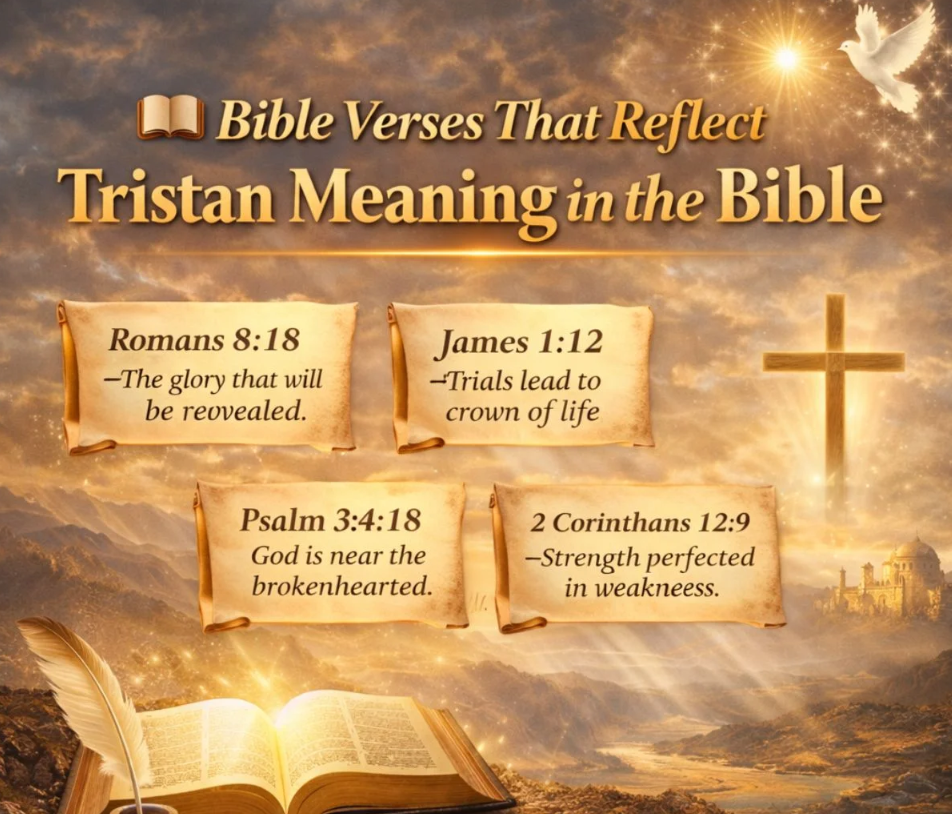
Bible Verses That Reflect Tristan’s Meaning
Even though Tristan isn’t named in the Bible, its themes appear clearly in Scripture. These verses help illustrate tristan biblical meaning, tristan faith meaning, and tristan religious meaning:
| Theme | Bible Verse | Connection to Tristan |
| Endurance through suffering | Romans 5:3-4 | Builds perseverance and character, reflecting Tristan’s journey from sorrow to strength |
| Transformation from sorrow to joy | Psalm 30:5 | “Weeping may endure for a night, but joy comes in the morning,” echoing tristan meaning sorrow turned into hope |
| Strength in weakness | 2 Corinthians 12:9 | God’s power is made perfect in weakness, connecting to tristan meaning strength |
| Overcoming trials through faith | James 1:2-4 | Testing produces maturity; Tristan symbolizes this spiritual growth |
| Comfort for the sorrowful | Matthew 5:4 | “Blessed are they who mourn, for they shall be comforted,” directly reflecting the spiritual insight of Tristan |
Spiritual Symbolism of Tristan
The spiritual symbolism of Tristan transcends mere narrative, embodying the dualities of love, loyalty, and inner struggle. In the context of his tragic romance with Isolde, Tristan represents the relentless pursuit of unattainable ideals. He becomes a vessel through which we can explore the nature of desire and its complexities; his love is both a source of ecstasy and profound sorrow.
Key aspects of Tristan’s spiritual symbolism include:
- Sorrow transformed into purpose: Life’s hardships shape character, echoing tristan meaning sorrow and tristan meaning strength.
- Faith under trial: Tristan symbolizes those who trust God through adversity, reflecting tristan faith meaning.
- Spiritual warrior identity: Like biblical heroes, Tristan represents courage and resilience, aligning with tristan spiritual meaning and tristan biblical symbolism.
- Redemptive endurance: The name conveys perseverance that leads to spiritual growth, embodying tristan religious meaning.
Is It a Good Christian Name?
Yes, Tristan is a good choice for a Christian name. It carries deep values of faith and hope. Even if it is not in the Bible, its meaning reflects God’s truth. It speaks of strength, trust, and restoration.
Choosing Tristan reflects:
- Perseverance – Enduring hardships with faith in God.
- Redemption – Seeing sorrow turned into joy.
- Spiritual resilience – Standing strong in trials.
Tristan in Legends vs Christian Truth
Historically, Tristan originates from Celtic legends, particularly the Arthurian tale of Tristan and Isolde. In these stories, Tristan is a noble warrior, often associated with love, bravery, and tragic hardship. This gives rise to the tristan historical meaning and tristan legendary symbolism, where sorrow and suffering are central themes.
While these legends capture the romantic and heroic dimensions of the name, the Christian interpretation reframes Tristan through spiritual truth. Tristan biblical meaning and tristan religious meaning focus less on romantic tragedy and more on divine purpose. Sorrow is not merely fate, it is an opportunity for spiritual growth. Strength is not just worldly heroism, it is God-given resilience.
Christian tradition transforms Tristan from a literary figure into a spiritual archetype:
- Sorrow into hope: Reflecting tristan meaning sorrow and tristan spiritual symbolism
- Endurance in trials: Mirroring tristan meaning strength and tristan faith meaning
- Moral courage and fidelity: Aligning with biblical principles of virtue and obedience
This juxtaposition highlights how the name can bridge cultural heritage and biblical truth, making Tristan both historically rich and spiritually relevant.
In the legend:
- Love is ruled by feelings and desires, not lasting commitment.
- Sorrow leads to loss and hopelessness, not healing.
- Fate is seen as the ultimate ruler, not God’s divine plan.
But in Christian truth:
- Love is grounded in sacrifice, selflessness, and covenant promises.
- Sorrow is not the end but a door to restoration and new beginnings.
- Trials are part of God’s purposeful design, not random events.
Conclusion
e name Tristan may not be found directly in the Bible, but its values can reflect strong Christian truths. When seen through the lens of faith, it carries themes of endurance, redemption, and hope in God’s plan. Rather than being defined by old legends, it becomes a symbol of strength and trust in divine purpose.
Choosing Tristan can be a meaningful decision for parents, writers, or anyone seeking a name that reflects courage and spiritual resilience. It reminds us that God can turn sorrow into joy, trials into growth, and every life story into a testimony of His grace.
FAQ’s
What is the meaning of Tristan in the Bible?
It is not directly in the Bible, but it can represent perseverance and hope in faith.
What is the meaning of Tristan?
Tristan is often linked to “sorrowful” or “bold,” depending on origin.
Is the name Tristan good?
Yes, it can be a positive and meaningful name when tied to Christian values.
Does Tristan mean brave?
In some interpretations, it can mean bold or courageous.
What is the Tristan meaning in Bible verse context?
It reflects enduring trials with faith, similar to biblical figures.
What is the Tristan meaning in Greek?
It is not originally Greek, so no direct meaning in that language.
What is the Tristan meaning in Hebrew?
It does not have a Hebrew origin or biblical root.
What does the name Tristan say about personality?
It may suggest someone strong, resilient, and faithful.
How is Tristan pronounced in the Bible context?
It is pronounced the same: Tris-tan.
What is the Tristan meaning in Bible Catholic interpretation?
Catholic meaning aligns with Christian values strength through trials.
What is the Tristan meaning in Hindi?
It is not a traditional Hindi name, so meaning may differ in that culture.
Is the name Tristan in the Bible?
No, it is not directly mentioned in Scripture.
Why do parents choose Tristan?
Parents love Tristan’s name , meaning Hebrew, because it combines courage, perseverance, and spiritual depth for their child’s character development.
