Long before “patron saint” became a phrase people use loosely, it meant something specific: a person believed to intercede for a particular group, cause, or struggle, based on how they lived or died. A short prayer connected to what you are facing. Mothers have Saint Mary. Musicians have Saint Cecilia. People navigating mental illness have Saint Dymphna. Each connection usually traces back to something real in that saint’s life, a profession, a hardship, a place, or a cause they were known for.
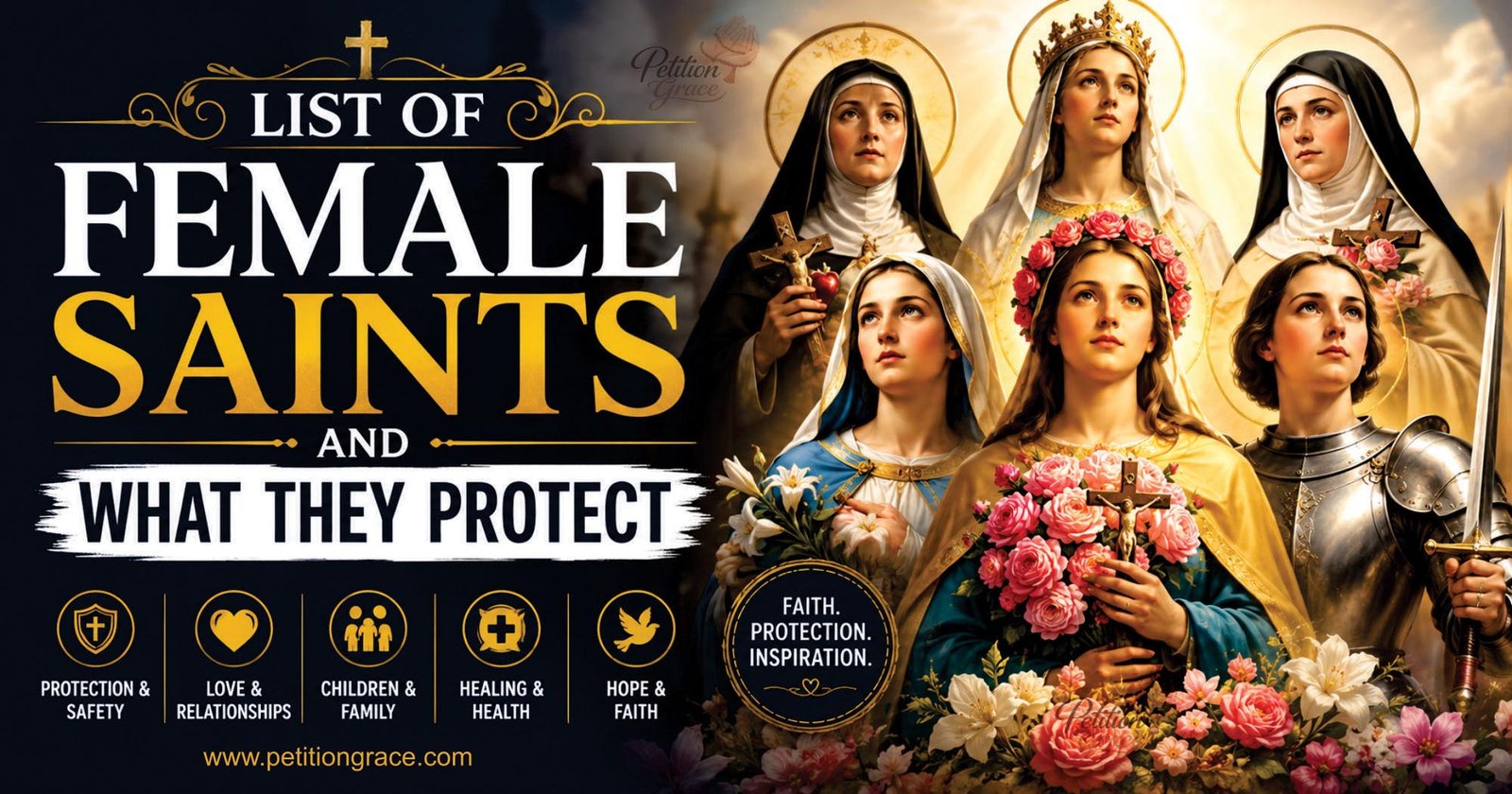
This is a complete list of female saints and what they protect, female Catholic saints and their patronage, their meanings, their symbols, and the women saints and their patronage that have followed their names for centuries. Whether you’re searching for a list of female saints for confirmation, looking at female patron saints and their meanings, or simply want to understand female saints and what they are the patron of, this guide is organized so you can find what you actually need: a saint connected to a specific struggle, a name for confirmation, or simply the story behind a name you’ve heard.
How Saints Become “Protectors” (Patron Saints Explained)
A patron saint isn’t officially assigned by a computer matching a saint to a cause; the connection almost always comes from their biography. Someone becomes the patron of sailors because they were a sailor, or were shipwrecked, or calmed a storm in a recorded legend. Someone becomes the patron of a mental illness because of how they cared for the afflicted, as with Saint Dymphna, who is invoked for nervous and mental afflictions because of the compassionate care she’s associated with in Geel, Belgium, a town still known today for its centuries-old tradition of caring for people with mental illness within ordinary family homes.
Some patronages are declared formally by the Church’s official canonization process; many others grew out of centuries of popular devotion and were never “assigned” by anyone in particular; they simply became tradition because enough people, across enough generations, kept turning to that saint for that same need. Not all Patron saints are women. ” Saint Anthony of Padua,” for instance, is invoked for lost things. This is exactly why a list of saints and what they protect looks the way it does: it’s less a fixed catalog and more a record of what people, generation after generation, have needed help with.
Famous Female Catholic Saints Throughout History
Female saints span nearly two thousand years of Christian history, and their stories come from wildly different eras: Roman-era martyrs like Agnes and Cecilia in the 3rd and 4th centuries, medieval mystics and reformers like Catherine of Siena and Hildegard of Bingen, and comparatively modern saints like Faustina Kowalska and Kateri Tekakwitha, canonized within living memory. What unites them isn’t a single era or background; some were queens, some were peasants, some were nuns, some were wives and mothers who never took religious vows at all. That range is part of why female saints and their meanings, female saints and their patronage resonate with such a wide variety of people today.
Female Saints and What They Protect
The female patron saints list and meanings below cover well-known names and a few lesser-known ones, each with the story behind their patronage.
Saint Mary, the Mother of Jesus
Known for: Mothers, families, all of humanity. As the mother of Jesus in Christian tradition, Mary is the saint most widely invoked across nearly every need, but she holds a particular closeness to mothers, families, and anyone seeking comfort in grief or uncertainty. Devotions to Mary take many regional forms (Our Lady of Guadalupe, Our Lady of Fatima, Our Lady of Lourdes among them), each tied to a specific historical apparition or tradition.
Saint Anne
Known for: Mothers, grandmothers, women in labor, homemakers. Tradition holds Anne as the mother of Mary and grandmother of Jesus; though she isn’t named in the Bible itself, her story comes from early Christian tradition. She’s especially invoked by women hoping to conceive, by grandmothers, and by those who care for family life day to day.
Saint Cecilia
Known for: Musicians, singers, composers. Cecilia is one of the most enduring patronesses in the arts. According to legend, she heard heavenly music playing in her heart during her wedding, the reason she became so closely tied to music. She’s often depicted with an organ, and musicians and church choirs still invoke her protection today.
Saint Agnes
Known for: Young girls, purity, chastity, engaged couples. A young Roman martyr from the early 4th century, Agnes is traditionally invoked by young girls and those seeking to live out their faith with integrity in the face of pressure. She is usually pictured with a lamb, a play on her name’s resemblance to the Latin agnus, meaning lamb.
Saint Teresa of Avila
Known for: People with headaches, those in need, Spanish Catholic writers. A 16th-century Spanish mystic, reformer, and Doctor of the Church, Teresa is known for her deep writings on prayer and the interior life. She’s often turned to by those seeking a deeper, more contemplative prayer practice, and, somewhat unusually, by people suffering from headaches, tied to a detail from her own health struggles.
Saint Joan of Arc
Known for: Soldiers, France, courage in the face of injustice. A teenage peasant girl who led French troops during the Hundred Years’ War before being tried and executed, Joan of Arc is remembered as a symbol of courage under persecution. She’s the patron saint of France and is often invoked by those needing strength to stand firm in a difficult, unjust situation.
Saint Monica
Known for: Mother of difficult children, patience. Monica is remembered for decades of prayer for the conversion of her son, who became Saint Augustine, one of Christianity’s most influential theologians. She’s the saint most often invoked by mothers praying for a child who has drifted from faith, and by anyone needing patience through a long, uncertain wait.
Saint Catherine of Siena
Known for: Nursing, Italy, people navigating illness. A 14th-century mystic and Doctor of the Church, Catherine cared for the sick during a plague outbreak in Siena, which grounds her connection to nursing and healthcare. She’s also a patron saint of Italy.
Saint Rita of Cascia
Known for: Powerful prayers for couples to change their lives. Difficult marriages, impossible causes, abuse survivors. Known as the “Saint of the Impossible,” Rita endured a difficult and reportedly abusive marriage before being widowed and entering religious life. She’s turned to by people facing situations that feel hopeless, and especially by women in painful marriages.
Saint Elizabeth of Hungary
Known for: Charity work, the poor, widows, bakers. A 13th-century Hungarian princess known for giving away food and resources to the poor despite her royal status, Elizabeth is closely tied to charitable work and care for those in need.
Saint Bridget of Sweden
Known for: Widows, Sweden, Europe. A 14th-century Swedish mystic, wife, and mother of eight before founding a religious order after her husband’s death, Bridget is one of the patron saints of Europe and is especially invoked by widows navigating life after loss.
Saint Barbara
Known for: Protection from sudden death, fire, lightning, miners. An early Christian martyr whose legend includes being locked in a tower by her father, Barbara became strongly associated with protection from sudden or violent death and, by extension, from fire, explosions, and lightning. She’s a long-standing patroness of miners and, more recently, of those working in explosives-related fields.
Saint Faustina Kowalska
Known for: Divine Mercy devotion, trust in hard times. A 20th-century Polish nun, Faustina recorded visions and messages that became the foundation of the Divine Mercy devotion. She’s invoked by those seeking trust and mercy during difficult, uncertain seasons.
Saint Dymphna
Known for: Mental illness, anxiety, nervous disorders, family trauma. A 7th-century Irish saint, Dymphna fled her home after tragedy struck her family and eventually died a martyr in Geel, Belgium, a town that, centuries later, is still known worldwide for its tradition of community-based care for people with mental illness. She’s one of the most invoked saints today for anxiety, depression, and mental health ( Prayers for Peace ) struggles, and for those recovering from family trauma.
Saint Kateri Tekakwitha
Known for: Native Americans, ecology, converts, orphans. The first Native American woman canonized a saint, Kateri was a 17th-century Mohawk-Algonquin woman known for her deep faith despite facing rejection from her own community after her conversion. She’s especially significant as a patroness of Native peoples, the environment, and those who feel like outsiders because of their faith.
Saint Hildegard of Bingen
Known for: Musician, writer, natural scientist, herbalist. A 12th-century German abbess, composer, writer, and healer, Hildegard is remembered for the breadth of her work; she wrote music, theology, and natural medicine texts centuries ahead of her time. She’s a patron of those working in the arts, sciences, and healing traditions.
Saint Brigid of Ireland
Known for: Ireland, dairy workers, newborns, nuns, travelers. Along with Saint Patrick, Brigid is one of Ireland’s patron saints. Her legends involve extraordinary generosity, including stories of dairy and food multiplying to feed the poor, which grounds her connection to dairy workers and those in need of provision.
Saint Odilia
Known for: Eye ailments, the blind. Legend holds that Odilia was born blind and received her sight at baptism, which is the root of her long-standing patronage over eye conditions and those who are visually impaired.
Saint Lucy
Known for: Eyesight, the blind, writers. A 3rd-century Sicilian martyr, Lucy’s name comes from the Latin word for light (lux), which likely helped cement her association with sight and eyes over the centuries. She’s traditionally depicted holding a pair of eyes on a dish.
Saint Clare of Assisi
Known for: Television, eye disease, embroiderers. A close companion of Saint Francis of Assisi, Clare founded the Poor Clares religious order. She became the patron saint of television in the 20th century after a story that she was able to see and hear a Christmas Mass on a wall in her room while too ill to attend in person.
Saint Veronica
Known for: Photographers, laundry workers. Tradition holds that Veronica wiped Jesus’s face with her veil on the road to his crucifixion, leaving an image imprinted on the cloth, the reason she’s associated with imaging and, by extension, photography in modern times.
Saint Perpetua
Known for: Mothers, expectant mothers, ranchers. A young mother martyred in 3rd-century Carthage alongside her slave, Felicity; Perpetua’s own prison diary is one of the earliest surviving texts written by a Christian woman. She’s invoked by mothers, particularly those facing danger or separation from their children.
Saint Josephine Bakhita
Known for: Human trafficking survivors, Sudan. Born in Sudan and enslaved as a child before gaining her freedom in Italy and becoming a nun, Bakhita is one of the most significant modern patronesses for survivors of trafficking and slavery, and for the country of Sudan.
Saint Frances Xavier Cabrini
Known for: Immigrants, hospital administrators. An Italian-American nun who founded dozens of hospitals, schools, and orphanages while serving immigrant communities in the late 19th and early 20th centuries, Cabrini was the first U.S. citizen canonized a saint and remains the patroness of immigrants.
Saint Thérèse of Lisieux
Known for: Missionaries, florists, those with tuberculosis. Known as “The Little Flower,” Thérèse was a French Carmelite nun whose “Little Way”, finding holiness in small, ordinary acts of love, has made her one of the most beloved saints of the modern era, despite dying at just 24.
Saint Gianna Beretta Molla
Known for: Mothers, physicians, unborn children.n A 20th-century Italian physician and mother, Gianna is remembered for choosing to continue a pregnancy despite serious health risks to herself. She’s invoked by mothers, doctors, and those making difficult decisions around pregnancy and family.
Female Patron Saints of Animals
A handful of female saints are specifically associated with animals and the natural world. Saint Hildegard of Bingen, already noted above for her writing and healing work, is also invoked by naturalists and herbalists for her extensive writings on the natural world. Legends of Saint Brigid of Ireland multiplying dairy and food have made her a longstanding patroness invoked by farmers and dairy workers for the wellbeing of livestock. Regional and folk traditions across Europe have also connected various local female saints to the protection of specific animals, particularly cattle and dairy herds, though, unlike Saint Francis of Assisi for animals broadly, there isn’t one single, universally recognized female patron saint of animals in general.
Female Saints and Their Symbols
Traditional Catholic art gave each saint recognizable symbols, usually tied to how they died or what they’re known for, useful if you’re trying to identify a saint from female saints pictures and names, in a painting, stained glass window, or holy card.
| Saint | Common Symbol |
|---|---|
| Saint Mary | Blue mantle, lily, crown of stars |
| Saint Cecilia | Organ or musical instrument |
| Saint Agnes | Lamb |
| Saint Lucy | Eyes on a dish, lamp |
| Saint Barbara | Tower, chalice |
| Saint Catherine of Siena | Crown of thorns, lily |
| Saint Dymphna | Sword, sometimes a chained figure at her feet |
| Saint Rita of Cascia | Wound on the forehead, crucifix |
| Saint Joan of Arc | Sword and armor, banner |
| Saint Clare of Assisi | Monstrance (a vessel for the Eucharist) |
Female Patron Saints by Nationality
Several female saints are closely tied to a specific country or people, often becoming a national patroness alongside, or instead of, a male counterpart. This is why searches for Irish female saints, French female saints, and Polish female saints are so common; heritage is often the starting point for choosing a saint.
- Ireland: Saint Brigid of Ireland, honored alongside Saint Patrick as one of Ireland’s patron saints.
- Sweden: Saint Bridget of Sweden, one of the six patron saints of Europe.
- France: Saint Joan of Arc, France’s national patroness, alongside Saint Thérèse of Lisieux.
- Italy: Saint Catherine of Siena, co-patroness of Italy.
- Poland: Saint Faustina Kowalska, whose Divine Mercy devotion is closely tied to Polish Catholic identity.
- Sudan: Saint Josephine Bakhita.
Choosing a Female Saint Name for Confirmation
One of the most common reasons people search for a list like this is far more personal than general curiosity; it’s for choosing a confirmation name. In Catholic tradition, choosing a saint’s name at confirmation is a way of asking that saint to walk alongside you as a spiritual role model and intercessor. This is exactly why searches for female catholic saints for confirmation, catholic confirmation names for girls, and saint names for girls are some of the most common ways people land on a list like this one.
A few ways people approach the decision:
- Choose based on a quality you want to grow in. Drawn to courage? Joan of Arc. Patience through a hard family situation? Monica. A calling toward the arts? Cecilia or Hildegard.
- Choose based on your own name or heritage. Many people pick a saint who shares their first name, or a saint connected to their family’s country of origin, Bridget or Brigid for Irish heritage, for example.
- Choose based on a struggle you’re facing. Someone navigating anxiety might be drawn to Dymphna; someone facing a difficult family relationship might feel a pull toward Monica or Rita of Cascia.
- Choose a “badass” or unconventional saint. Not every confirmation name has to be gentle or quiet; saints like Joan of Arc, Perpetua, and Josephine Bakhita are often the pick for people drawn to cool female saints and stories of defiance, survival, and strength rather than quiet piety.
There’s no wrong approach; the point of a confirmation name isn’t finding the “correct” saint, it’s finding one whose story genuinely resonates with where you are in your own faith. Popular female saint names for confirmation tend to cluster around a handful of names, Mary, Catherine, Elizabeth, Agnes, Cecilia, Rose, and Faustina among them, but plenty of people choose a name specifically because it isn’t the most common one on the list.
FAQs
Can women be saints?
Yes. The Catholic Church has canonized women since its earliest centuries; Mary, Agnes, and Cecilia are among the oldest venerated saints in Christian history, and women continue to be canonized today, including relatively recent saints like Faustina Kowalska (canonized 2000) and Kateri Tekakwitha (canonized 2012).
What is the best saint name for a girl?
There’s no single “best” one; the strongest choice is usually a saint whose story or virtues genuinely connect with the person choosing it, rather than the most popular name on a list.
Who is the patron saint of girls?
There isn’t one single official patroness of “girls” broadly, though Saint Agnes, a young martyr herself, is one of the saints most often invoked by and for young girls and teenagers.
Who is the patron saint of women?
There also isn’t one single universal patron saint of women as a whole. Women saints and their patronage tend to cover very specific life stages instead; Mary holds the broadest role across Christian tradition, while saints like Anne (mothers), Monica (wives and mothers), and Gianna Beretta Molla (mothers and physicians) are invoked for more specific stages and struggles in women’s lives.
What is the first female saint?
Mary is venerated as the first female saint in Christian tradition. Among early canonized martyrs, women like Agnes and Cecilia are among the earliest venerated by name in the Church’s history.
Are there any “badass” or unconventional female saints?
Quite a few. Joan of Arc led troops into battle as a teenager. Perpetua wrote her own prison diary before her martyrdom. Josephine Bakhita survived enslavement and became a symbol of freedom and forgiveness. Female saints aren’t a uniform archetype; their stories range from quiet devotion to open defiance of power.

I’m Shujaat Magsi, the writer behind petitiongrace.com. My words are rooted in faith, gratitude, and everyday hope. Through uplifting blessings, heartfelt prayers, Bible Prayers and inspiring reflections, I aim to encourage peace, kindness, and spiritual strength—offering comfort and purpose in every season of life.